Case Study
How We Built Convira: A Chatbot Development Services Case Study
A Complete Product Case Study
This case study is for anyone curious about how a modern SaaS product is architected, built, and scaled. We're going to show you exactly how we built Convira (www.convira.chat), an AI chatbot platform that competes with products from companies that have raised millions in funding.
But more importantly, we're going to explain WHY we made each decision. Because when you understand how a team builds products, you can better evaluate whether they're the right team to work with.
Here's what we'll cover:
- • The core architectural challenge: serving thousands of customers simultaneously
- • The technology stack we chose and why
- • How we designed the landing page to convert visitors into customers
- • How we handle payments, security, and deployment
- • The key decisions that shaped this product
1. The Core Challenge: Serving Thousands of Customers Simultaneously
Before we talk about technology, let's talk about the real problem every SaaS founder faces: how do you serve thousands of customers at once without your servers melting down or your costs spiraling out of control?
The Problem No One Talks About
When you're building a chatbot platform, you're not building one chatbot. You're building a system that lets hundreds or thousands of businesses each have their own chatbot — with its own data, its own conversation history, its own configuration, and its own users hitting it simultaneously. That's multi-tenancy. And it's the hardest architectural problem in SaaS.
Our Approach: Session-Based Multi-Tenancy
Each chatbot gets its own isolated context:
- Unique Conversation Threads: Every chatbot instance maintains its own conversation history. The data is tagged with the chatbot's ID, not the user's ID.
- Separate Vector Embeddings: When a chatbot is trained on content (website pages, PDFs, documents), those embeddings are stored separately. Customer A's knowledge base never mixes with Customer B's.
- Isolated API Calls: When a user chats with a chatbot, the request includes the chatbot ID. Our backend routes that request to the correct context.
- Per-Chatbot Rate Limiting: Each chatbot has its own rate limits. A viral chatbot doesn't consume another chatbot's quota.
| Component | How It Handles Multi-Tenancy |
|---|---|
| Supabase (PostgreSQL) | Row Level Security (RLS) policies ensure every query is automatically filtered by chatbot_id. |
| GPT-4 API (via OpenAI) | Each chatbot request includes the chatbot's context. We don't share conversation history between chatbots. |
| Next.js API Routes | Each API endpoint validates the chatbot ID, checks ownership, and routes to the correct data context. |
| Supabase Auth | Users authenticate, and their session includes both their user ID AND their chatbot IDs. |
2. The Technology Stack
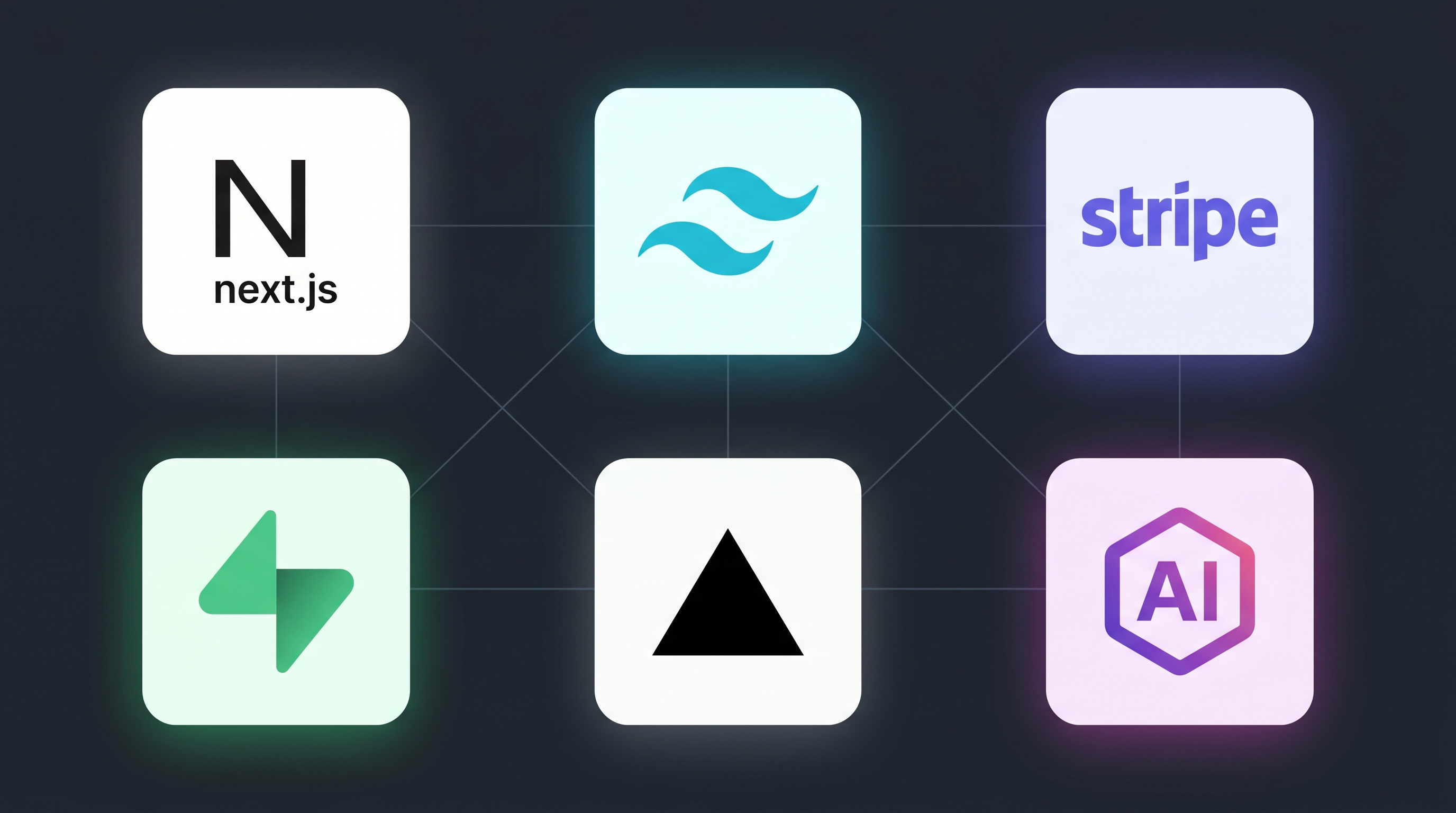
| Layer | Technology | What It Means for Your Project |
|---|---|---|
| Frontend | Next.js 14 (App Router) | Your site loads fast, ranks on Google, and works on all devices |
| Styling | Tailwind CSS + shadcn/ui | Consistent, beautiful design without the custom CSS nightmare |
| Animation | Framer Motion | Smooth interactions that feel premium, not jerky |
| Payments | Stripe | Reliable billing that handles trials, subscriptions, cancellations |
| Database | Supabase (Postgres) | Your data is secure, fast, and accessible only to you |
| AI/LLM | GPT-4 (via API) | The most capable AI model for understanding customer questions |
| Hosting | Vercel | Your site deploys automatically, loads globally in seconds |
| Domain | Cloudflare | Fast DNS, SSL security, DDoS protection |
Why We Chose Next.js 14
Next.js is the industry standard for modern web applications. It provides Server-Side Rendering (SSR) for fast page loads with content already present, Static Generation for instant-loading pages, and excellent SEO with proper meta tags and structured data.
Why We Use shadcn/ui + Tailwind CSS
shadcn/ui gives us pre-built, accessible components that we own completely — no licensing concerns. Combined with Tailwind CSS, we can make changes quickly. One change in our configuration updates everywhere.
Why We Use Supabase
PostgreSQL under the hood with Row Level Security (RLS) ensures every piece of data is protected. Built-in authentication handles sign-up, login, password reset, email verification. Real-time capabilities handle live updates natively.
3. The Landing Page Strategy
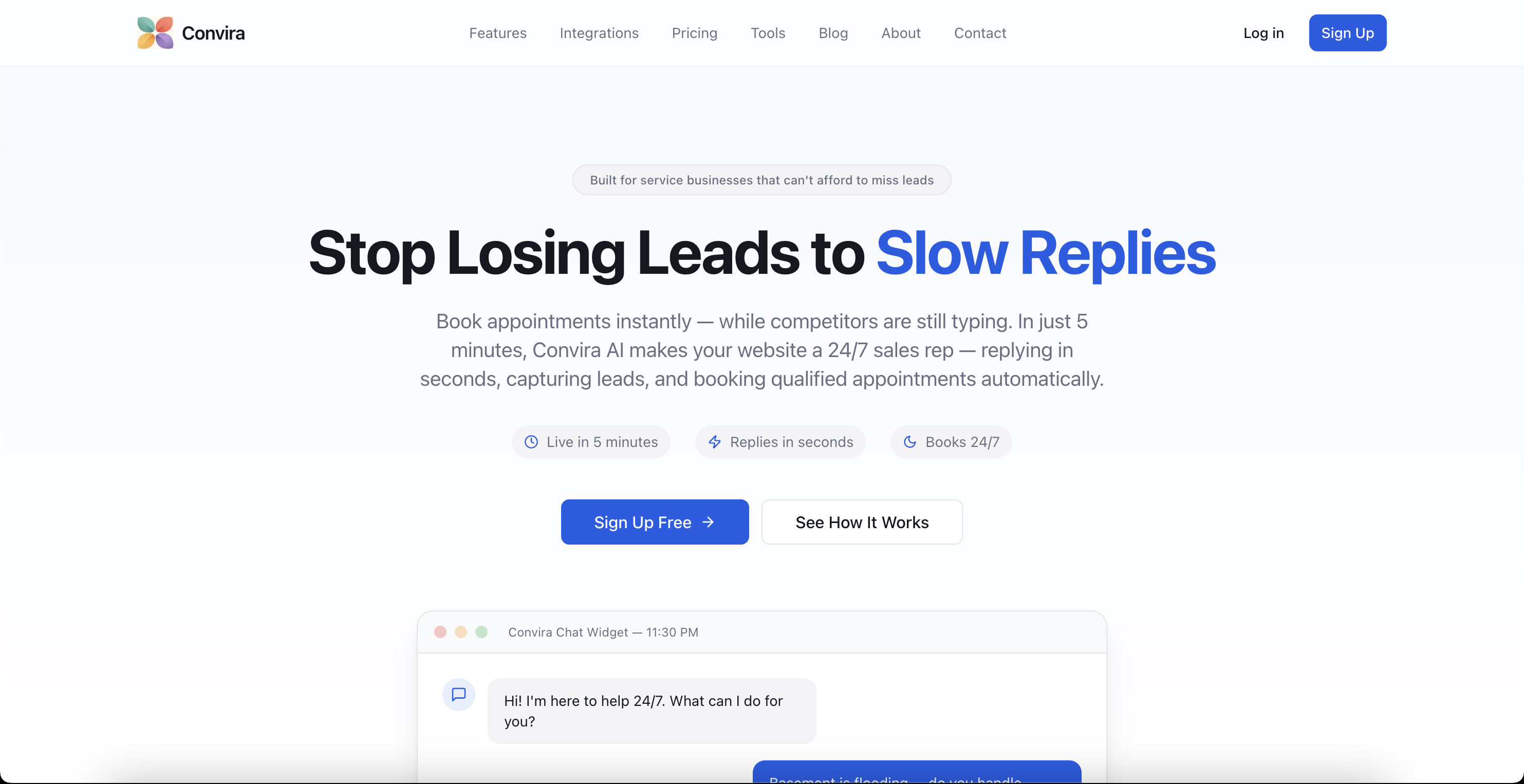
Your landing page is your sales team. It works 24/7, never takes vacations, and doesn't have bad days.
What Most Companies Get Wrong
Visit most AI chatbot company websites and you'll see hero sections packed with technical jargon, feature lists that read like software spec sheets, and no clear explanation of what the product actually DOES. That's backwards. Your visitors don't care about your technology — they care about their problem.
We designed Convira's landing page around outcomes:
- 1. Hero: Clear value proposition — "AI chatbot that answers questions and captures leads while you sleep"
- 2. Before/After: Shows the transformation — manual support vs. automated AI
- 3. How It Works: Three steps, no technical knowledge required
- 4. Scenarios: Real examples by industry (e-commerce, SaaS, agencies)
- 5. Features: Framed around business outcomes ("Cut support costs" not "Vector embeddings")
- 6. Pricing: Clear, upfront, self-serve
The Component Architecture
Each section is isolated — built as its own component, loaded dynamically. We use Next.js dynamic imports with ssr: false for scroll animations using Intersection Observer, lazy loading for faster page loads, and easy A/B testing and updates.
4. Payments and Subscriptions
We use Stripe for all payment processing. Two key pieces: a Webhook Handler that receives events (checkout.session.completed, customer.subscription.updated, customer.subscription.deleted) and a Cancel Endpoint for self-service cancellations. We always verify Stripe webhook signatures to prevent fake "payment successful" events.
5. Security: Row Level Security
We use Supabase's Row Level Security to ensure data isolation. Every database query is automatically filtered by the current user's ID. Users can only see their own chatbots, leads, and settings. Even if there's a bug in our code that accidentally returns all records, RLS blocks it at the database level.
6. The Design System
We use shadcn/ui + Tailwind CSS. shadcn/ui is different from traditional component libraries — you copy their components into your codebase, you own them completely, can modify anything, no licensing concerns. Combined with Tailwind CSS, changes are incredibly fast. One class change updates the entire site.
7. Deployment: Vercel
We host on Vercel, the company that created Next.js. Zero-Configuration Deploys — every git push automatically triggers deployment. Preview Deployments — every pull request gets its own preview URL. Edge Network — your customers get fast load times wherever they are. Instant Rollbacks — roll back to the previous deployment in one click.
8. Key Decisions: What You Should Look for in an Agency
1. Start with a Landing Page, Not a Full Product
We didn't build the entire product first. We built a landing page that explained the vision, collected email addresses, and validated demand before writing a single line of product code.
2. Use Established Tools, Don't Build Everything
Stripe for payments. Supabase for database and auth. Vercel for hosting. These are solved problems. We don't reinvent them.
3. Treat Content as a Growth Channel
We wrote 27 blog posts. They generate thousands of visits every month. That traffic is free — it doesn't disappear when we stop paying for ads.
4. Build Tools That Attract Your Audience
We built 17 free tools. They don't make money directly, but they attract our target audience and build trust.
5. Make Everything Self-Serve
Our entire signup → trial → paid flow works without human intervention. No sales calls, no "contact us for pricing."
6. Ship in Public
Our codebase, our case studies, our process — it's all public. This builds trust.
9. What We're Still Working On

Content Gaps
- • Multilingual AI chatbots: One post, but massive opportunity
- • Chatbot security and privacy: Enterprise buyers ask about GDPR compliance
- • Chatbot analytics: Content on metrics, dashboards, ROI tracking
- • FAQ targeting: Questions like "How much does a chatbot cost?"
Product Improvements
- • Better onboarding flows for new users
- • More integration options with CRMs and helpdesk tools
- • Improved analytics dashboard
- • Multi-language support in the chatbot itself

Ready to Build Something?
If this case study resonated with you, let's talk. We build products the right way — validated, scalable, with real growth strategies baked in from day one.
The results speak for themselves: 27,000+ monthly organic visitors, a product that competes with funded startups, and a codebase we're proud to show anyone.
Get in Touch →Built with Next.js, Tailwind, Supabase, Stripe, and Vercel. Hosted on a global edge network. Secured with Row Level Security. Optimized for both humans and search engines.